Thoughts • Insights • Process
Looking through differences Lens
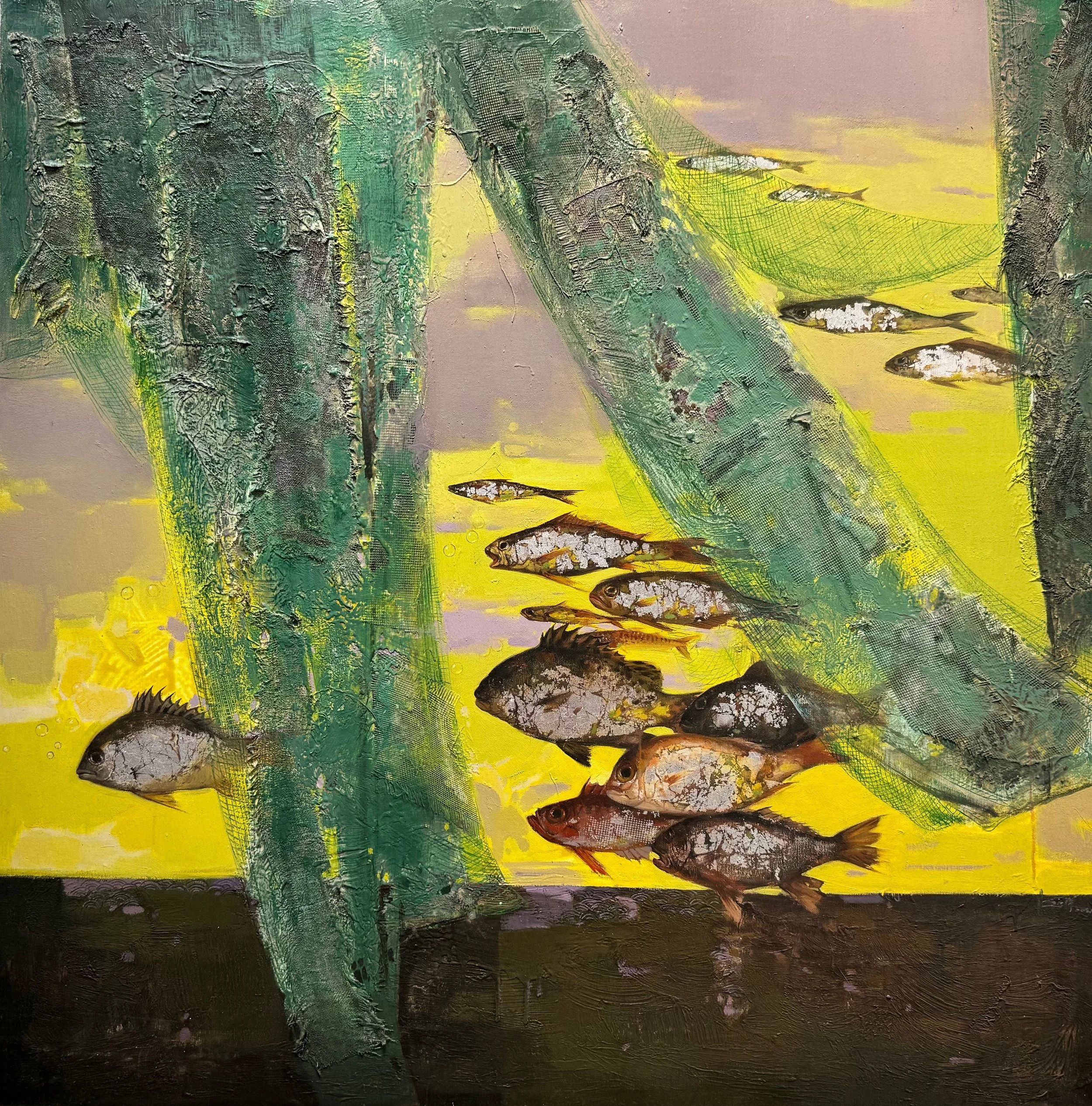
One brave fish turns toward the golden light — and already, some others begin to follow, creating a tender ripple of awakening through the entire school.”
No Net Ensnares My Soul
In this luminous painting, a single fish becomes the quiet pioneer — the first to see the great emerald net of inherited culture and whisper the liberating words: “No net ensnares my soul.” Yet it does not swim alone. Several fish from the entangled school have already begun to turn and follow, their bodies gently angling toward the same radiant light.
What we witness is the most intimate and hopeful moment in the human journey: one soul’s awakening becomes the gentle invitation for others to follow. Culture remains beautiful and present, yet its threads are no longer binding — they become the silken background against which freedom quietly spreads.
A painting of profound tenderness and shared courage.
Yet even as one brave fish turns toward liberation, the painting invites us to look closer at the net itself — revealing a deeper psychological truth about how culture silently shapes what we see and how we move through the world.
This painting presents a deceptively simple yet psychologically charged scene: a large green fishing net suspended against a glowing yellow field, with a school of fish swimming through — or entangled within — its mesh. At first glance, it appears to be a straightforward depiction of fishing. But when viewed through the lens of cross-cultural social psychology, particularly Morris and Peng’s (1994) seminal “fish experiment,” the work becomes a profound visual metaphor for how different cultures explain social behavior.
In their classic study, Morris and Peng created animated displays of fish swimming in a lake. American participants consistently attributed the behavior of a fish that swam apart from the group to internal dispositions — leadership, independence, or personal drive. By contrast, Chinese participants explained the same behavior in terms of situational and relational forces — group pressure, social context, or external circumstances pulling or pushing the fish.
The painting “Caught in the Net” brings this exact psychological tension to life. The net itself functions as a powerful symbol of cultural structures — the invisible yet tangible systems of norms, roles, expectations, and social obligations that shape human movement through the world.
• In collectivist cultures, the net represents the containing, protective, and defining force of family, community, and tradition. The fish inside the net are not swimming alone; their identity and direction derive meaning from their place within the school. To remain inside is to belong; to break free is to risk disconnection and loss of context.
In individualistic cultures, the net can feel more like a constraint than a support. The fish that strain at its edges or swim just outside it embody the cultural ideal of autonomy and self-determination. Freedom is prized, even if it means leaving the safety and coherence of the group.
What makes this work especially compelling is that it does not take sides. Instead, it invites you — the viewer — to examine your own cultural conditioning and implicit theories of behavior:
Where in your life do you experience the “net” as a source of belonging and guidance?
Where do you feel the urge to swim beyond it in pursuit of independence?
How much of your sense of self is shaped by the cultural mesh you were born into, and how much have you consciously chosen to keep or release?
By pausing before this canvas, we gain a mirror not only for the painting’s surface but for our own unspoken assumptions about what it means to be an individual and what it means to be part of something larger than ourselves. The tension between autonomy and belonging is not merely philosophical — it is a daily psychological reality lived differently across cultures.
We hope this painting encourages you to see more clearly — not only the artwork, but also the invisible nets that shape us all, and the quiet freedom that comes from recognizing them.